A Cup A Cup A Cup A Cup A Cup

You may sip from your Canteen or Pack Hydration Badder. You might guzzle from your Can or gulp from a Bottle. Wine Skins are cool if that's what you're into and of course you might chance a sip directly from the source (dangerous) but if you camp sooner or later, you'll need a Cup.

How stupid does that advice sound? Bring a cup.
Well there are Cups and then there are Cups. In survival school, students often are required to make their own Bowls and Cups, not to mention Spoons and a Fork now and then. Luckily we don't need to do all that (although it is a very cool project) we can bring suitable Cupage on our treks.
But what kind?


One of the most common and useful cups for camping is of course the old enameled steel "cowboy" cup. These chipped workhorses of the back country dinning room have been around for centuries.
With good reason, they are rugged and smart looking. I think the inevitable chipping just adds to their eye appeal.
Here is a modern version of the classic, instead of blue with white speckle it is black and has an unpainted rim. It reminds me of the night sky and I think it is a sharp looking cup. Many seasoned trekkers know that although heavy, these cups offer their owner some interesting features. For instants, the cup cools quickly. This might sound like a disadvantage but the contrary is true. These things get HOT. The warmth is transferred to the hands and if you've ever watched a cowboy movie you know what I'm talking about. The old saddle trap, collar up hat down sitting around the fire, huddled over a cup warming his hands, face as well as his insides. It's a drinking experience.


The purpose made "Camp" cup is handy in size and weight. It's aluminium composition makes it a joy to carry.

Along the same lines, the plastic camp cup is lite and even graduated in some examples such as this one. This can be handy when preparing meals that require measurement of water or other ingredients.


The "new" standard is of course the stamped "wire" handle camp cup. Generous and tough these cups are great for just about any use, even as a small cook pot. I can't tell you how many meals of soup or noodles I've whipped up in these. The bail style wire handle keeps it manageable when hot.

The military had a similar idea and has produced "canteen" cups for the troops that have folding wire or in this case stamped metal handles. Nice size, well made, very heavy.


Not to be out done the military Mess Monkeys over seas made a design that IS more frying pan then cup but does a bang up job.


The "D" rings on the handle enable the cook to add a stick of wood to extend reach or avoid burning hands.


Some cups suffer an identity crisis, they don't know if they are cups or pots or frying pans. what this usually means is they are hardly adequate at any of those jobs. Such is the cup on the Svea 123 stove.


It's a sad little cup just trying to fit in. The handle is removable.


Suspiciously missing from my list of camp cups is of course the classic Sierra cup. This cup is a bit strange to me, it's design is wide at the top and narrow at the base. To me this seems a bit tipsy having so small a footprint and the ultra wide mouth cools the drink off so fast I find it counter productive. If you've ever seen a nautical mug used on ships at sea, you understand how and why they work. The wide base keeps them from tipping and the narrow chimney style opening keeps the steamy brew from cooling to fast. Why would any one want a cup with reverse features? The Sierra cups do look cool and make a neat micro fry pan but I think the idea was under thunk.
So many cups to chose from one might wonder what cup is the chosen vessel for you. Only you know what would work best however. Strong, lite and packable cups make the best drinking buddies.
You might ask what the tiny cowboy cup is used for.


So let us lift a glass to the cup.
Bottoms up.

Safe travels
RJ

FILTER MODIFACATION

Katadyn Hiker
Conversion - Modification, The "HIKER" is an excellent filter. Many wilderness travelers know and trust the HIKER and it's next generation incarnation the HIKER "PRO".
The "PRO" has a number of quick attachment points that make it convenient to affix to almost any water bottle/hydrator but its most important feature is a "pre-Filter" wrapped around the primary glass filter. This allows you to separate larger contaminates from the system before they reach the main filter body.
A very cool idea.
So cool in fact, I copied it and here is how I do it.
The filter of the Katadyn is rated to be 0.3 microns or as I refer to it THREE MICRONS we all know about the zero point sizing. Katadyn makes no reference as to the micron value of their pre-filter, only that it saves the main filter some exposure and clean up time.
I make a pre-filter in the 0.7 micron or SEVEN MICRON size that knocks down the exposure of contaminants to the primary filter CONSIDERABLY!


Beyond the pre-filter card, I also take steps to pre-filter the intake line as well. Katadyn supplies a screen type cylinder as a catch for it's intake line. This works but after some time needs to be cleaned. In particularly slimy water it may need immediate attention before it can be used again.


So I found that wrapping the intake line with material that can be cleaned or changed made the job easier. The pantie hose works like a charm. Bring on the swamp water.


Three of these pantie hose covers usually will last me a year of regular use.
As if the Hiker was not enough, in my paranoia I chemically treat the raw intake with Aerobic Oxygen, Iodine and or Bleach before I pump it through the filter.

This I am confident provides me with safe, fresh tasting "sterile" H2O while in the bush.

Lugol's iodine solution was once used as a disinfectant but tastes like s*@& as does Halazone but is stable in the long term. If you like the smell and taste of month old pool water then Halazone is the treatment for you. The HIKER and HIKER PRO will clean up the taste.

We learn by listening and watching, experimenting and testing but above all by sharing. A good idea is worth stealing anytime.

Safe travels

RJ

Cool and Rainy Day

TEA
That's what I needed, (and an excuse to play with a Stove) With the rain soaking my prospects for an "outdoor" adventure, I settled for a hot brew in the shed. It had been a long time since the smell of wood smoke had wafted into my nose so the plan was to burn some.

On the "stove" shelf in my shed is one or two (Six) home made wood and or alcohol burners I constructed while under the incurable shakes of cabin fever.

I opted to use a coffee can variety today seeing how I had plenty of wood and precious little alcohol, plus I love the way smoke lingers and settles on rainy days so all in all it was a first class plan.


Being inside without a cross breeze to evacuate the smoke produced by the can stove, I used a small window fan to draw out the smoke. If this had been a "Wood gas" stove, the efficiency of the preheated air and recirculated smoke would have made this spot of tea almost smokeless.

The advantages of fueling a stove with indigenous fuel is of course the weight factor. Bottled and canned fuel is heavy and costly. Wood, Pine Cones, Bark and other natural materials abound and are light wight and lets not forget free.

Of course the standard cry of the gas bottle camper will be : What if it's raining and everything is wet? Good point, but counting on wood as your fuel for cooking, light, and warmth is always a challenge. Those that know how to find-gather-light damp wood will always find a way, those that cannot need to learn or move down a rung on the food chain.

A can stove is so user friendly only those incapable of starting a fire will be at odds with it. They burn hot and very clean. What ashes they do produce are slight and easy to redistribute into the environment again (cool and safely of course) without detection.

The real secret is in the preparation. Wood needs to be pencil sized or there about and roughly the size of the receptacle (burning chamber of the can). I use a fixed blade knife and baton (stout stick) to split my can stove fuel. Although time consuming, I find it pleasurable and therapeutic. I'm always impressed by how much LESS wood I burn in the can stove as apposed to in a campfire. The concentrated and controlled heat does the job so much better and the embers last a bit longer. The ambiance is lacking but hey, what can I say? The lack of bright fire light will make star gazing that much easier.

Dry wood can almost always be found even in the dampest forest if you know where to look. Thankfully this stove uses so little that a hand full or two will be all that is necessary to produce a hot meal and steaming brew.

The "WoodGas" stove is one of the best trail stoves you can use and I plan to pack one on my next trip, but the Hobo can stove is a cheap lite weight alternative as well. Enough plans for these exist on the Internet for you to find a model that suits your needs and creative ability. Try it instead of the gas bottle stove some time, prepare a meal or two in the yard or on your patio to get the feel of how much wood will be needed and what it takes to tend one. You might be pleasantly surprised.

Safe Travels

RJ

OLD FRIENDS

HOLY CRAP!
The Vibram Gods only know how many miles my boot heels have seen over the years. Although many of these steps were lone introspective trips that challenge no one but me, at times the crunching sound of foot steps in front or behind me was a comfort. Over the years I have shared tent and trail with many very interesting people. My traveling companions were an eclectic mix of funky forest philosophers more akin to Tolkien's fellowship then average trekkers. At times we had much in common, at other times we were as different as stones on a beach but the one commonality that always seemed to be evident was kind regard, respect and concern for each other. I felt safe and at total ease with these guys and could be myself.

As much as Sam is my Son and Russel my Brother these trekkers were my crew. No leaders or followers, no egos or competition. As far as we knew all of our penises were the same size or so we thought and no display from "Alpha" males was necessary or tolerated.
I missed that trusted unspoken type of camaraderie. I don't crew trek anymore.

We grew up and walked different paths (and trails) the only evidence left to recall these days were some photos buried in a box deep in my closet.
Until just the other day.

Happenstance reunited two of us that had not spent time together in fifteen plus years. Tom and myself have jobs that occasionally allow us to bump into each other every ten years. It was always good to see him but we were working and no time could be carved out to really visit. On our last chance encounter he mentioned that Mike, another member of the "old" crew was in the area visiting family.
Mike had moved away twenty years or so earlier without asking permission and relocated in far off places known only to level six members of the witness protection program and Dick Chaney. But now Mike had returned to challenge a local white water river while on vacation. We did the smoke signal thing and made tentative plans to group up and do something together for old time sake.

The plan was Kaaterskill Falls........

It was very good to see my old friends again. Time had changed them only slightly. Tom and I both had fancy new medical devices. My pace makers due to genetic predisposition and lack of exercise and Tom's bad knees due to an unfortunate direct high velocity cranial impact with a rouge south bound apple pie. Mike had a steamer trunk with an enviable amount of travel stickers plastered on it to prove he was not afraid to wonder.

Just like old times we set straight to work. Plan "A" pizza and beer!We didn't let the fact that Trusty Rusty broke down or the fatal motor vehicle accident or the twenty two mile detour stop us. After a stop for lunch to kill time (none of us really needed to eat) we planned our assault on New York State's highest waterfall.

I was forced to live with an Itty Bitty Espresso.........unfair

The high steep region of the Catskills is undeniably beautiful. The trees were just showing a blush and the sky was that ultra bright blue that begged to be white. The air was cool, crisp and seemingly clean. The detour was picturesque as it rolled along the ravines and saddles of unnamed mountains ever climbing. The roads were narrow with little to no shoulders and I just had to stop to shoot a pic or to.
A look down over the side of the road found what looked like an El Camino that lost control on this narrow road some years ago. I could only hope it's driver survived the crash and I was briefly reminded of the loss of life the made this detour necessary. Life can be so short, it is important that we take full measure of our blessings.........

On to the hike. I just knew the accident would keep the hiking traffic down and we would have much of the Gorge and the falls to ourselves.................NOT!


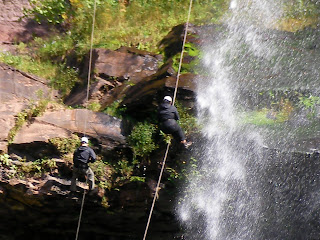
The crowd under the falls milled about snapping shots of the hissing water. We met with other like minded nature lovers and compared cameras while exchanging well memorized lines from Eastwood's Eiger Sanction (guys with grey hair know these sort of things) as we watched a couple rappel the upper falls.
Tom wisely opted to wait under the lower falls while Mike and I climbed. His knee was playing hell with him and he needed to work the grave yard shift this night. So after being frisked for unregistered ballistic pastries, we left for the main cascade.
Places like this are really magic, the low angle light of afternoon caused a rainbow to dance across the pool under the falls.

The rock was warm and cool both at the same time depending on the sun's track. Lush greenery clung to rock that seemed to cling to nothing, the thermals shifted around as we squinted in the bright light. Everything was alive and beautiful. I was impressed by the noticeable lack of litter, testimony to the character of those who walked the rocks with us although I must say we did seem to find many abandoned articles of clothing here and about. I can only imagine the sensation of skinny dipping in such a place. The waterfall and the bright star light must have been a life changing experience to someone (or two) again the Pantheist in me calls.


While I took time for a SPOT check in, I wondered the smooth rock and admired the strange patterns in the stone.


I sent three OK messages out of the gorge, when I check later that day only two had be received. With the high escarpment behind me I was not surprised the satellite geometry was impaired. Never the less, I would have been rescued as a short matter of course. SPOT rules!


On our way back out of the gorge we had the pleasure to be introduced to Mr. Ted Hill, Flower stick champion of Salinas California. Ted did not have a juggling assistant (he could have used one) but he did have a great promoter. A rather interestingly dress women in long skirts and clogs who went out of her way to ensure we got Mr. Hill's name right.
See you on Letterman Ted.


Finding each other again after all these years was a gift. I am pleased to see my friends are reasonably healthy, happy and still doing some of the things we once did.
Just when one starts to feel old, things can happen to rejuvenate the soul.
Thanks Guys. Lets do this again real soon.

The Safest of Travels.
RJ

SURVIVAL STUDY

A Real Page Turner
I have studied the science and art of wilderness survival and "Primitive living" skills for the last thirty years as a hobby,vocation and life style. In that time I have amassed several books on the subject. Not being much of an armchair adventurer, I prefer to practice my hobby hands on but reading these books has taught me much and given me the chance to put into practice the techniques used by others.
I spend alot of my "spare" time tying Trout flies but my quiet time is most often spent reading. The subject of choice is almost always something having to do with the outdoors.
Wilderness survival can be a fascinating subject, it can also be repetitious and gets stale. There is only so much the average person will read and even less will be put into practice.

I don't think anyone really learns it all and like anything else some authors are better writers then others and therefore better teachers. Like any teacher we might have liked in high school or professor in collage, some just know how to convey an idea better. So it's not that any of these books are "really" better then others, it's just a matter of writing style.
At last counting, I think I own close to one hundred books on the subject of survival. I am not counting those I liked enough to buy more then one copy of either, this is an honest count.
I have learned something from each of them, but there are those that were so special and touched my soul in ways that have changed my life. I have put the lessons I've learned from these books to the ultimate test in the bush and found that they were just as the author described.

A real page turner......I can give you lists if books (and will) that are worth reading and deserve study and practise however, there is a short list of MUST read books that I believe any wilderness trekker is compelled to have in his/her library.
Without hesitation I can attest to the quality of those books written by Alan Fry and Paul H. Risk. These two men give full measure on the subject in two distinctly different styles. In my opinion no survival library would be complete without the books Outdoor Safety and Survival (Risk) and Wilderness Survival Handbook (Fry) if you don't already own these books stop right now and leave the COSS blog page, Google them up and buy them........just do it...you'll thank me.
As a very good second string is anything by John and Geri McPherson and J. Wayne Fears These names are familiar to the survival community but if you don't own their books by now you're just not serious enough yet.
On the third shelf and again no disrespect intended it's just a matter of preference in writing style, you should read Barry Davies and Raymond Mears our English cousins tend to be fanatical about the subject and have strong opinions about how one should survive with style. This brings us to the time honored writings of Bradford Angier a bit dated but valuable. And who could forget the lessons of Larry Dean Olsen.
You may notice I left out "he who must not be named!" The Tracking guru from New Jersey. I have read all the books he has ever written and must say..........he just doesn't do it for me.
I can appreciate the whole American Indian thing but, like the contributions of Bear Grylls, I can smell a commercial enterprise when the wind is just right. It's just not what my spirit is looking for. (Hey Bear, whats with all the running?)

I'm 50 years old now and have schlepped through the thickest bush of the largest piece of wilderness in the Continental United States (The Adirondacks) and even after more then a month in the bush have never found it necessary to wring out a turd for a drink, do a back flip from the top of a waterfall or teach Tommy Lee Jones how to kill a man in old Indian fashion. Sorry, I'd rather eat berries then Bullshit.
Now from survival to Backpacking: two books we should never be without are Walking Softly in the Wilderness (John Hart) and one of my very favorite books The Camper's Companion (Rick Greenspan & Hal Kahn) just great reading in an informative yet fun style. ....more please guys.

Study any and all U.S. and foreign military survival manuals (some are better then others) but believe it or not most are vague and need instructors to fully convey what a better author can teach.
Last but not least on the must read list is The Boy Scout Handbook it is almost like a bible to me. It teaches much more then how to live in harmony in the wilderness, it teaches how to live a better life. Lessons worth learning by everyone.

Whatever you read/study put it to practical use. Try it in your back yard or local woods and get familiar with the techniques before needing them in the deep bush. remember it's good to learn from your mistakes (if you survive them) but it's better to learn from the mistakes of others.
These few books contain those lessons.

Safe Travels
RJ

BEARS!

BEARS in the wood
We have all camped or hiked and run into Bear sign. In many ways this is exciting, in other ways it is unnerving. Ask any tenderfoot what he fears most in the wild and Bears will almost always be at the top of the short list. But why?

Most of us have never had a "run in" with a Bear, in fact most of us have never seen a Bear in the wild. Just like the Grey Wolf, the Black Bear has a terrible reputation that is 99% undeserved.
Oh I have heard stories of attacks and maulings by Black Bear but almost always these have been caused by man himself.

We "visitors" to the green wood tend to bring along our bad habits. Along with those habits come consequences.

Bears do what Bears do, you will never find them stealing your SUV from the parking area and going on joy rides, nor will you find them stretched out on the sofa of your vacation cabin watching Regis in the morning. They seem to get into the same kind of mischief all the time and it is almost always because of one thing, FOOD!

Man brings things into the forest that most Bears have never smelled before. These things attracted Bears for a number of reasons, hunger and ease of acquisition being first but also curiosity as well. A Bear might eat your deodorant just because it smelled different (not good just different)

Even smoke can draw attention from Bears who have learned that smoke means food under the right conditions.

Never bring food of any kind into the tent, even for an instant. Cook down wind of your sleeping area and don't wear your sleeping clothes while cooking or around the campfire.

If you smell like a Mountain House meal or Hot dog the Bear is bound to try and taste you. Candy is a BIG no no. leave it and your trail mix with the food bag (high in a tree)

In my area of concern the Black Bear is the only real Bruin I need to worry about.


He is known to be poor of sight but incredibly keen of nose. A Black Bear smells you long before he sees you or your camp. He will approach from down wind and at a distance of several hundred yards knows what your making for breakfast, God help you if it's pancakes and maple syrup. He has a propensity towards sweets and can sniff out a Snickers bar in your tent no matter what it's in.

LEAVE FOOD OUTSIDE THE TENT!!! Hang it high in a tree and five feet from the trunk, Black Bears are extraordinary climbers. Trash is another attractant. Whats garbage to you is a feast to the Bear. Where legal, burn what will burn, or better still, PACK IT OUT!

The most dangerous time to confront a Bear is when Mom is with Cubs. Keep this in mind. YOU ARE THE ENEMY! She does not care if you were just communing with nature with your ipod playing John Denver as you watch the splendor of the natural world........She will kill you! Stay away, Keep back!


As my friends in the parks department would say, you are about to have a
BEAR ENCOUNTER.

These are seldom pleasant. Carry a whistle, wear a Bear bell laced into your boot (a round bell the size of a large marble much like a sleigh bell) these stupid little noise makers may save your life. As you walk the constant ching ching warns the Bear that something different this way comes.

My key ring almost always is clipped to my side, on it is five must have keys a p38, fero/magnesium rod and a Best brand whistle. The clanging as I walk is reminiscent of a gunfighters spurs in a grade B western BUT it makes noise and I like it.
Should I need to "go stealthy" I tuck the ring in a pocket and I'm kool as Christmas but for much of the time it tells the world I"M COMING", I like that.

Advanced Bear protection might include an early warning system set up around camp when you tuck in for the night. I don't always bother but in areas where Bear sign is fresh I hang my Bear bells and other clanging items like cans or "CLEAN" mess gear from dental floss around the perimeter. The floss is strong and the little plastic box fits well into my kit. Keep it off the ground by a foot and a half and the Skunks/Raccoons wont bother you all night. Sleep with your whistle and when the clanging starts it's flashlight and whistle time.

OK, lets say you did your best but the plan did not survive intact and you are face to face with a Bear. Now what??

Make yourself BIG, put your arms over your head to increase your over all height, yell, scream use the whistle, stomp up and down...you know, act like a jerk.

Most times the Bear will stop or run off. If the Bear holds his ground, shakes his head from side to side like a dog throwing off water after a bath or Clicks his teeth as if chewing...you are in a bad place my Brother and better you then me, prepare for an attack um-ah I mean a Bear Encounter. If you have Bear spray NOW is the time to have it in your hand. Shake the can well, I keep mine in the outside pocket of my primary pack so I can draw it like a handgun. It gets shaken regularly while I move and is almost always ready. Bear sprays are not the same as the sprays you might carry for defence against muggers so don't try to carry one of these units instead of the REAL thing.
Bear spray shoots farther and is usually oil based instead of water based (it spreads and adheres)the droplets are much smaller giving better coverage and these units are larger to allow for enough "juice" to stop a charging bruin. Aim at the Bear's head and fire a short blast at his nose/eyes. When hit the Bear should stop in his tracks and even rear up in pain. This stuff is hot (don't worry it wont do any permanent damage to the Bear) If he tries to wipe it off with his paws or digs his nose into the ground that's a good thing, he will only spread the oil into his eyes/skin producing the desired affect. Be prepared to fire again just in case, oh and be prepared to run....fast.
The Bear may run into the forest to lick his wounds or he may run right over your tent trying to get to the forest after all he can't see or smell, he is in pain and scared. He only wants out so don't get in his way.
Even if you only use it once, replace your Bear spray unit after discharge. GET A NEW ONE! The seal might begin to leak once the initial shot is fired and never TEST your spray. You might save this unit as a back up for the cabin or for a second hiker in your party but never rely on it as your primary Bear spray again.


The American Indians knew how to deal with Bears...they left them alone. Usually only the medicine man could sport a Bear robe...this was heavy duty ju ju and for good reason. Bears are to be respected and left alone to live unmolested by man.

However seeing how we are entering into his domain it should be us that protects his reputation. Don't make a Bear a menace by feeding him or disturbing his den areas. Leave him alone and you will both live longer.

Pick up a can of Bear spray, learn how to use it and keep it ready (your whistle and bell too)

I am not a hunter of Bears, I have seen them in the wild and observed from distance (just the way I like it) I mean him no harm and wish only good things for my Brother the Bear. That's why I leave him be!


Now this guy is another story. Thank goodness I don't have any of these Big Bastards around my woods.
My Friend Mike was nibbled on by a Grizzly Bear just a few steps from his home in Alaska. Mike was out for his morning jog when out came Griz and down went Mike. Being a well trained outdoors man he knew what to do if this ever happened (first soil pants) and his second nature kicked in. He had been trained to cover and roll and protect his head and neck from the powerful jaws of the Grizzly or as I call them the:
Mankillus eatem upus!

He survived the attack (encounter) and made the grade by being in the local paper.....Mankillus eatem upus attack of tender tasty man from Anchor Point Alaska..man survives / bear claims running shoes tastes like chicken, details and recipes at 5:00

Mike Dude, buy some spray....


Safe Travels
RJ